
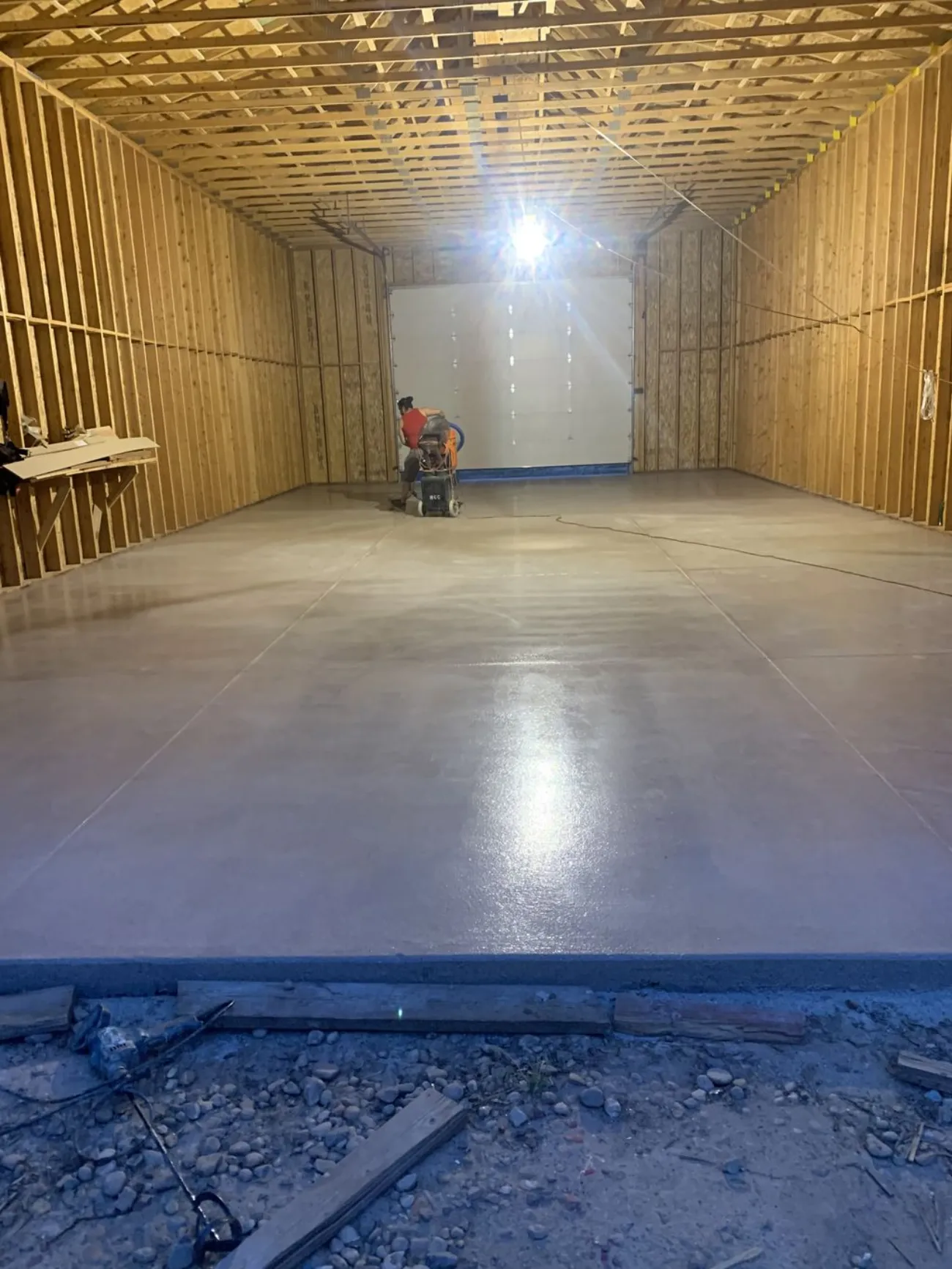
Commercial Floor Coating Options in Denver: Which System Fits Your Space?
For most commercial spaces in Denver, the answer is a high-build epoxy base under a polyaspartic top coat. That pairing takes traffic and chemicals, and it can be back in service in about a day. Kitchens and breweries are the exception. Hot washdown water shears epoxy off concrete, so those floors want urethane cement.
We spec commercial floor coatings off how the room gets used. Four answers decide it. What rolls across the floor, and what gets spilled on it. Whether it gets hot or wet, and how long you can afford to close.
Which system fits which kind of space?
Epoxy builds thickness. Polyaspartic buys speed and holds its color in sunlight. Urethane cement survives heat. Stained and polished concrete keeps the slab itself as the finished floor. Most commercial jobs use two of these together, a base and a top coat, rather than one product doing everything.
| System | Best fit | Back in service | Watch for |
|---|---|---|---|
| High-build epoxy | Warehouses, storage, light manufacturing | Days; hardest at 5 to 7 | Ambers in sun, poor under heat swings |
| Polyaspartic top coat | Service bays, showrooms, tight closures | Often about 24 hours | Short working window, costs more |
| Urethane cement | Kitchens, breweries, washdown areas | Per the product data sheet | Textured, not a showroom look |
| Stained or polished concrete | Retail, taprooms, offices | No film to cure | Shows the slab history |
What does a warehouse floor need?
Build thickness and hardness. Forklift wheels concentrate weight into a small contact patch, and steel forks get dragged. Thin coatings shear off under that. Common guidance for forklift traffic starts around 30 mils of build, several times what a big-box kit leaves behind.
Aisle marking is the other warehouse item. OSHA requires permanent aisles and passageways to be marked wherever mechanical handling equipment is used. The rule names no color and no width, and 4-inch lines are the usual practice. We build striping into the coating so traffic cannot peel it up.
Dock doors are where Denver shows up in a warehouse spec. Snowmelt, magnesium chloride off the truck tires and freeze-thaw all work on that slab edge. Those spalls get repaired before any coating goes down. Skip that and the new floor telegraphs the same damage within a season or two.
What about auto bays and service shops?
Service bays see the chemicals epoxy likes least. Brake fluid, battery acid and solvents all attack a standard build. A 100% solids epoxy base with a polyaspartic or novolac top coat handles that exposure. Novolac epoxy is the heavy end, rated for strong acids and some solvents that strip ordinary resin.
Hot tires are the other test in a shop. Rubber that just came off I-70 in July grips a weak coating harder than the coating grips the slab. That is a prep and cure question rather than a product question. It is the whole subject of why epoxy floors fail.
Why do restaurant and brewery floors need something different?
Heat. Sherwin-Williams puts fryer oil at 375F and sanitation washdown water at 185F. A sudden 150F swing can degrade an epoxy floor. Cementitious urethane, usually called urethane cement, expands at close to the same rate as concrete. It handles swings over 200F without letting go.
Colorado’s retail food rules shape the floor too. Under 6 CCR 1010-2, indoor floors have to be smooth, durable and easy to clean. They also have to be nonabsorbent in prep areas, warewashing areas, walk-ins and anywhere sprayed down. Floor and wall junctures have to be coved and closed to no larger than one thirty-second of an inch.
Where water flush cleaning is used, the same rule calls for drains and a floor graded to drain. The coving has to be sealed. A resin floor with an integral cove base does that well, because there are no grout lines to scrub. Confirm the specifics with your plan reviewer, since the local health department runs the inspection.
Brewery floors stack sugars, caustic sanitizer and keg traffic on top of hot liquid. Same answer in the wet zones: urethane cement in the brewhouse and around the drains. Out front is a different room, and plenty of taprooms use stained and polished concrete in the seating area.
How much grip does a commercial floor need?
ANSI A326.3 sets 0.42 wet DCOF as the minimum for level interior floors that get walked on wet. Where oil and grease are in play, like a fry station, 0.55 is the accepted target. We reach those numbers by broadcasting aluminum oxide or quartz into the top coat.
Grip has a cost. The rougher the surface, the harder it is to mop. So the aggregate goes where water and grease actually land: entries, dish pits, brewhouse floors, walk-in doorways, ramps and dock aprons. The rest of the floor stays easy to clean.
Is polished concrete a better fit than a coating?
Sometimes. Polished concrete is the slab itself, ground and refined, so there is no film that can delaminate. It suits retail floors, offices, taprooms and warehouses with a sound slab. It will not hide damage, and it will not hold off chemicals the way a resin floor does.
The catch is the slab you already have. Old patches, saw cuts, deep oil stains and past repairs all show in a polished floor. On a rough slab, a pigmented epoxy or flake build is the better buy, because it covers instead of revealing.
How long will the floor be out of service?
Downtime usually drives the whole spec. A full epoxy build wants several days before vehicle traffic, and reaches full hardness around day 5 to 7. A polyaspartic system is often back to traffic in about 24 hours. That gap is where polyaspartic earns its price on commercial work.
Temperature sets the calendar. Epoxy needs roughly 50F and rising to cure right, and it prefers 65F to 85F. An unheated Denver warehouse in January is a polyaspartic job, not an epoxy one. Polyaspartic cure also tracks humidity, and our air is dry. Denver runs near 51% on average, and mid 30s on summer afternoons. Dry air slows the reaction a little, which we plan around. The full comparison is in epoxy vs polyaspartic.
When the floor cannot close at all, we stage it. Half the warehouse, one bay, or the kitchen line over two nights. It takes longer overall, and it needs a plan for how product and people move around a wet edge.
What does Denver add to the spec?
Magnesium chloride comes in off I-25 and I-70 on truck and forklift tires all winter. Freeze-thaw works on dock aprons and drive-in bays. And strong sun at 5,280 feet comes through storefront glass onto showroom floors.
Mag chloride is the one people miss. CDOT uses it on state highways. Lab work on chloride deicers shows it reacts with cement paste and shortens concrete service life. A sealed floor keeps that residue on top of the coating instead of in the slab. Rinse it out in the spring.
The sun matters on any floor with daylight on it. Bare epoxy ambers under UV, and it shows badly on a white or light gray showroom floor. A polyaspartic clear coat holds its color, so that is what goes on top when the floor is on display.
What we look at before quoting
We ask the boring questions first. What rolls across it, what gets spilled, how hot the water is, how often it gets cleaned and with what. Then we look at the slab: cracks, spalls, old coatings, oil contamination, drains and door thresholds.
If the slab or the site gives us any reason to doubt it, we test moisture before specifying. A calcium chloride test (ASTM F1869) should read 3 lb per 1,000 square feet per 24 hours or less. An in-slab humidity probe (ASTM F2170) should read 75% or less. A coating manufacturer can set a tighter limit, and theirs wins. A high reading means a vapor-barrier primer, not a coin flip.
You get the prep, the system, the sequence and the return-to-service dates in writing before anything starts. That is how every commercial and industrial floor we quote gets put together. Tell us what the floor has to survive and we will come look at it.