
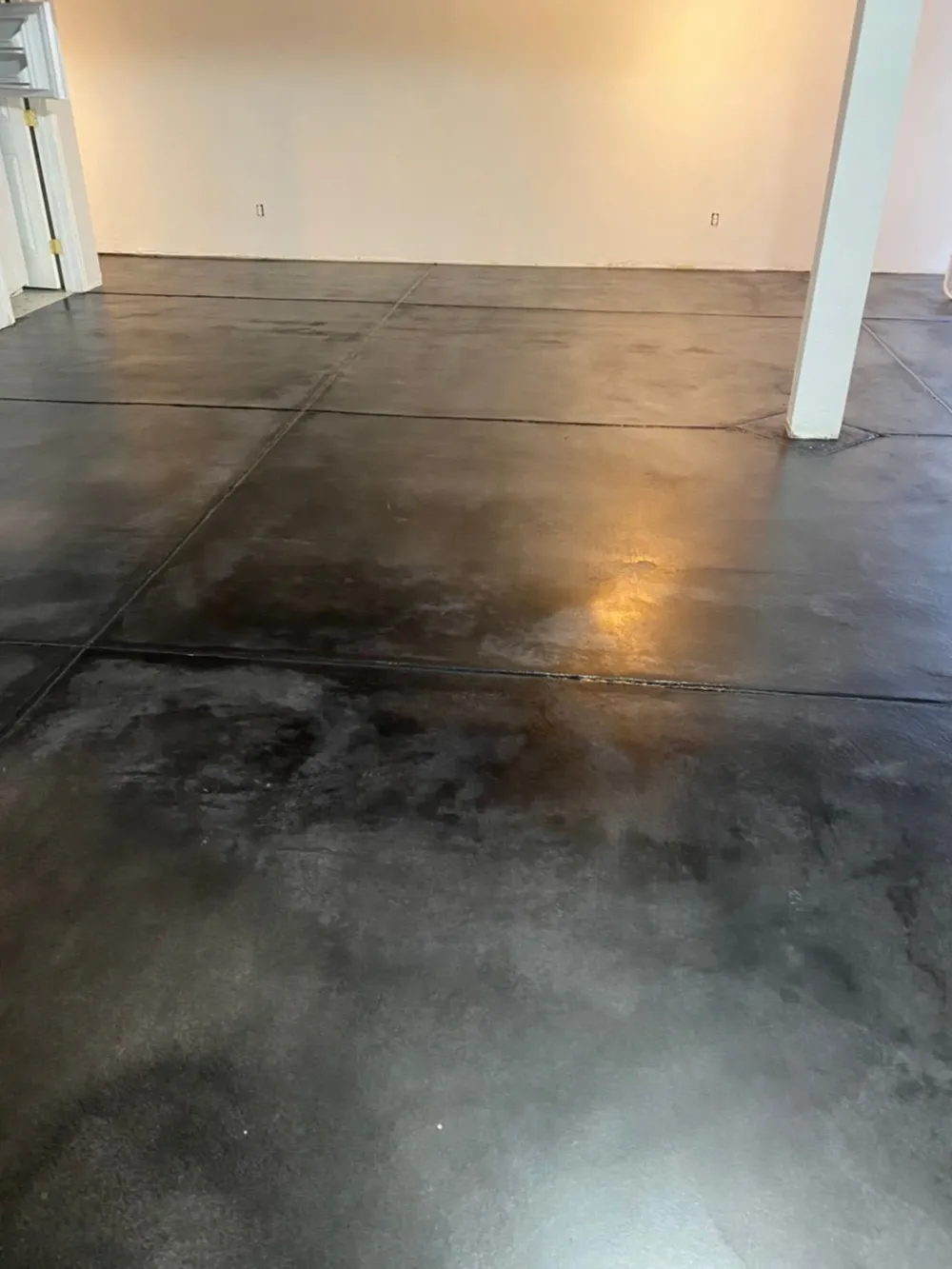
Polished Concrete vs. Epoxy Coating: Which Is Right for Your Denver Space?
Polished concrete is the slab you already have, ground and sealed. An epoxy coating is a new surface built on top of it. Polished concrete suits sound slabs in interior rooms that should look natural. An epoxy coating suits garages, shops and any floor that has to hide damage or take chemicals.
Both are on our list, so there is no house favorite here. Your slab and your room decide. In Denver the differences that matter are cost, basement moisture, road salt and altitude sun. Stained and polished concrete and a coating also fail in different ways, which is often what settles it.
What is the actual difference?
Polished concrete is a process rather than a product. We grind the slab through finer and finer diamond grits until it reaches the clarity you want. Then a densifier hardens the surface and a sealer goes on. The shine comes out of the concrete itself, since nothing gets added except color and sealer.
An epoxy coating builds a new floor over the old one. Primer, base, flake or metallic pigment where the finish calls for it, then a clear top coat. Film thickness is the point. It levels minor imperfections and puts a non-porous layer between the slab and whatever lands on it.
That one difference explains most of the trade-offs. A polished slab cannot peel, because there is no film to let go. It also cannot hide anything, because you are looking at the concrete.
Which one costs more?
They overlap more than people expect. Published ranges for the Denver area:
| Floor | Published range per square foot |
|---|---|
| Basic polish, lower sheen | $3 to $5 |
| Mid-level polish | $5 to $8 |
| High-gloss polish, more passes | $8 to $12 and up |
| Stain or dye added to a polish | add $1 to $4 |
| Solid color epoxy | $3 to $6 |
| Flake epoxy system | $4 to $8 |
| Metallic epoxy | $6 to $12 |
National cost guides put polished concrete at $3 to $12 per square foot, in the same tiers. Sheen is the price ladder on a polished floor, since each extra grinding pass is more labor.
Over a longer horizon the two separate. A coated floor gets recoated eventually. Published lifecycle comparisons put polished concrete lower on upkeep for that reason. A polished slab gets re-sealed or re-polished instead of stripped and rebuilt.
In a home that rarely decides anything. On a 10,000 square foot commercial floor it can.
Which handles a Denver basement better?
Moisture settles this one, not looks. Nearly every Denver house has a basement, and a below-grade slab sits against damp soil. Unless it was poured over an intact vapor barrier, it can move vapor up through the concrete for years.
An epoxy coating is a film. Vapor pushing up has nowhere to go, so pressure builds underneath until the floor blisters and delaminates. A polished slab is breathable: the densified surface slows vapor down, and what is left passes through instead of collecting under a membrane.
That makes polished concrete a forgiving basement floor, with one catch. Put a film-forming sealer on it and you are back to a film. So a basement gets tested first, then either a penetrating sealer or a moisture-tolerant coating system. Our rundown of basement floor options in Denver walks through the rest of that decision.
Which one belongs in a garage?
A coating, in almost every case. Denver garages take magnesium chloride off I-25 and I-70 all winter. It rides in on tire treads and drips onto the slab. Salt works into the pores of bare concrete and breaks the surface apart from inside.
A polished slab is still concrete at the surface. A penetrating sealer slows salt and water down. It does not put a film between the mag chloride and the cement paste. Freeze-thaw runs hard here too, and the garage slab sees more of it than any other floor in the house.
So garages get garage floor coatings: flake for value, metallic where the floor is meant to be seen, with a polyaspartic clear over either one. Polished concrete stays inside the house.
Plenty of homes end up with both. Stained and polished concrete in the finished basement, a flake coating in the garage. Different rooms, different jobs.
How long does each one take?
A coating is a sequence with waiting built into it. Grind, patch, prime, base, broadcast, then clear, and the resin sets the pace. A full epoxy build wants days before a car goes back on it. A polyaspartic top coat cures in hours, which is how a garage gets used again inside a couple of days.
Polishing has no cure windows to wait on. It has passes. The slab gets ground repeatedly through finer grits, densified, then sealed, and a bigger floor simply takes more passes. We run vacuum-assisted equipment to keep silica dust down, which matters when the family is staying in the house.
Neither is a same-day floor. The difference is where the time goes: chemistry on a coating, machine hours on a polish.
How does Colorado sunlight affect each one?
Both can shift color, in different ways. At 5,280 feet the sun is stronger than in most of the country. NOAA puts UV intensity up roughly 4% to 5% for every 1,000 feet of elevation. Denver sits around 20% above sea level.
Bare epoxy ambers under UV. That is a property of the resin, not a defect, and on a white or light gray floor it shows. A polyaspartic clear coat prevents it, which is why we top coat with one as a matter of course.
On a polished floor the risk is the color, not the sealer. Concrete dyes are not UV stable and will fade or darken in direct sunlight, so they belong in interior rooms. Acid stain reacts chemically with the lime in the slab and holds its color far better in daylight. In a walkout basement or a sunroom, that difference decides which coloring goes down.
Which is easier to live with day to day?
Both clean easily and neither asks for much. A polished floor takes a dust mop and a neutral cleaner. A coated floor takes the same, plus a rinse in spring. Otherwise ice melt residue sits on it all summer.
Repairs work differently. A chip in a coating gets patched and blended, and a poor patch reads as a shiny spot. A scratch in polished concrete gets polished out, because the finish is the material. Neither repair is invisible.
Sound is worth a thought. A high-gloss polished floor in a large empty room is loud. Coated floors are hard surfaces too, so rugs end up in the plan either way.
What about a commercial floor?
The answer flips more often on commercial work. Warehouses, showrooms and retail floors with sound slabs are good polished candidates. There is no recoat cycle, and a scrubber with a neutral cleaner handles upkeep.
Commercial and industrial coatings win where the floor sees chemicals or needs a specific slip rating. They also win on a beaten-up slab. Downtime pushes the same direction. A fast-cure polyaspartic build can go down over a weekend, while polishing a large floor takes passes and time.
Which one will your slab allow?
This is the question most people skip. Stain and polish reveal the history of a slab rather than covering it. Old patches read as patches. Saw cuts, spill marks and the line where a wall used to stand all become part of the floor.
Deep oil contamination is worse. It resists stain and shows as blotching, and there is no fixing that afterwards. On a slab like that, a pigmented epoxy or flake system builds over the problem.
So the order is simple: look at the concrete, then pick the finish. We grind and assess before recommending anything. If your slab is a poor candidate for polished concrete, you will hear it before you spend money. Let us look at the floor and we will tell you which one it wants.