
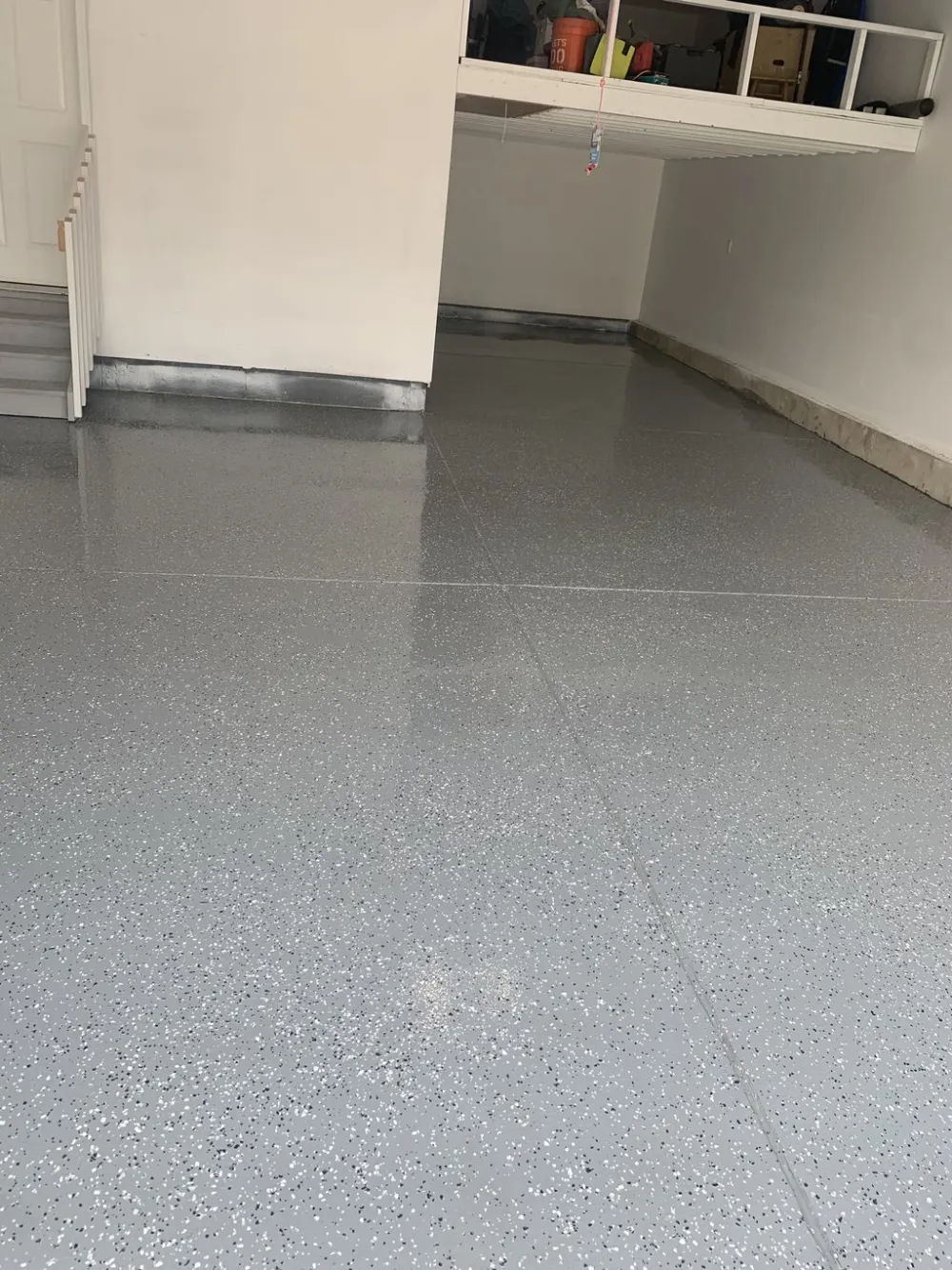
Epoxy Flooring Cost in Denver: Price Per Square Foot for Garages, Basements and Commercial Floors
National cost guides put installed epoxy flooring at $4 to $10 per square foot. The number for your slab comes from a free on-site walk-through and a written quote.
Other national guides run the range wider, at $2 to $12 per square foot. Prep is most of that spread. A pitted, oiled slab takes far longer to get ready than a clean one. We price epoxy flooring in Denver from the slab in front of us.
What does epoxy flooring cost per square foot?
The system you pick sets the rate. Here is what the national cost guides publish per square foot, installed.
| System | Published installed cost per square foot |
|---|---|
| Solid color epoxy | $4 to $10 |
| Full-broadcast flake | $4 to $12 |
| Metallic epoxy | $5 to $12 |
| Polyurea | $5 to $10 |
| Polyaspartic | $5 to $12 |
Solid color epoxy is the cheapest system here. You get one flat color with a clear coat over it. It suits a shop floor or a rental garage where the floor has a job to do and nothing else.
The guides do not give full-broadcast flake its own line. They fold it into the garage floor coating range of $4 to $12 per square foot. The chip gets broadcast into a system that is already priced by the foot. Heavier flake coverage moves a quote up inside that range.
Metallic is the most hand-worked finish on the list, and it prices like it. Our guide to metallic epoxy floor cost breaks that system out on its own.
Polyaspartic top coats sit at the top of the published range. They hold their color in sun, and they keep curing when epoxy stalls in the cold. In an unheated Colorado garage, that buys you winter install dates.
What does epoxy cost for my space?
Run the published per foot range across a real floor and you get the table below. Read these as market ranges. Your floor gets its own number.
| Space | Size used | Installed cost |
|---|---|---|
| One-car garage | 240 sq ft | $720 to $2,900 |
| Two-car garage | 360 sq ft | $1,100 to $4,300 |
| A 20 by 20 room | 400 sq ft | $1,600 to $4,000 |
| A 12 by 12 room | 144 sq ft | $576 to $1,440 |
| Any 1,000 square foot floor | 1,000 sq ft | $4,000 to $10,000 |
| A basement | 1,000 sq ft | $2,800 to $11,500 |
| A small commercial floor | Priced by the foot | $12 or more per sq ft |
Three of those rows are estimates we ran. They are the 20 by 20 room, the 12 by 12 room and the 1,000 square foot floor. Each one is the published $4 to $10 per foot range multiplied by the area. The other rows are published totals.
Bigger floors land nearer the low end of the per foot rate, and small rooms land nearer the top. That holds for every row in the table. It surprises people on a small room or a single bay.
Look at the two answers for 1,000 square feet. Our estimate lands at $4,000 to $10,000, while one guide puts a 1,000 square foot basement at $2,800 to $11,500. That gap is why a written quote beats a calculator.
Published guides price commercial and industrial floors by the foot rather than by the room. A system built on 100 percent solids starts at $12 or more per square foot.
Why do two Denver quotes differ so much?
Published Denver cost data puts a one-car garage at $795 to $3,180 per project. A three-car garage runs $2,390 to $9,530 per project. Labor in the same Denver data runs $1 to $7 per square foot, or $50 to $150 per hour.
Altitude sets the specification here. Denver sits at 5,280 feet, and the sun is hard on resin. Plain epoxy ambers outdoors and in sunlit rooms. A UV-stable top coat belongs inside the system rather than on an options list.
Winter sets the prep. The state sprays magnesium chloride on I-25 and I-70 all season, and tires carry it home onto the slab. Snowmelt collects just inside the garage door, and that is where spalling shows first.
Freeze-thaw is the other local cost. Front Range slabs expand and contract all season, and water that gets into bare concrete freezes and pops the surface. Expansive clay under the slab swells when wet and shrinks when dry. Cracks open, edges lift, and a coating quote has to price that repair first.
The biggest split between two quotes is grinding versus acid etching. We diamond grind every floor, then prime it. Etching leaves a surface skin that hot tires lift.
The low bid is often a different product entirely. Garage floor coating systems live or die on that one step.
Hot tire pickup is the failure people describe to us most. A warm tire sits on a thin coating and lifts it in patches. A ground slab with a real primer under the build holds instead.
Prep is where the money goes
Square footage is the biggest lever. Per foot cost drops as the floor grows. Setup, masking and cleanup cost about the same on any size floor. A single bay carries the highest rate per foot.
Slab condition comes next. Published guides put grinding off a failed coating or a DIY kit at $2 to $5 per square foot, and concrete floor resurfacing at $3 to $7 per square foot. Concrete resurfacing and repair is the fix for a slab that is pitted, scaled or low in spots.
Moisture matters most below grade. A basement slab can push vapor up through the concrete and blister a coating. One national guide puts a moisture barrier at about an extra $1 per square foot. Our basement floor coatings get a moisture reading before anything goes down.
Access and layout round out the list. Hauling grinders and vacuums down basement stairs takes longer than rolling them into a garage.
Are DIY epoxy kits worth the savings?
Published guides put a DIY epoxy floor at $2 to $5 per square foot. Raw materials run $50 to $600, and premade kits run $200 to $700. On paper that reads like half price.
Those kits ask you to acid etch the slab with a bottle of solution and a stiff broom. Etching does not open concrete the way a diamond grinder does. The coating grips the surface skin instead of the slab.
Failed big-box kits are the most common thing we grind off. Add the published $2 to $5 per square foot for removal and the savings are spent. Our guide to what drives a garage floor coating quote runs the same math for a garage.
How to read two Denver quotes
Two quotes on the same floor can sit thousands apart for real reasons. Put them side by side on these points.
- Prep. Is it listed line by line, or folded into one word?
- Grind or etch. Ask which one, and get the answer in writing.
- Flake coverage. A full broadcast to rejection uses far more chip than a light scatter.
- Top coat. The product type should be named on the page.
- Moisture. On a basement slab, ask whether the floor gets read first.
- Square footage. The quote should state the number it priced.
A quote that names the prep, the grind, the top coat and the footage can be compared. A one-line total cannot.
One more question is worth asking every bidder. What happens if the crew opens the floor and finds more damage than the quote covered? Get that answer before anyone starts, in writing.
Getting a real number for your floor
We come out, measure the floor and read the slab. Then we put the prep, the system and the price in writing. The number holds unless the scope changes.
We coat residential and commercial floors across the Denver metro and the Front Range. We are open seven days a week. The walk-through and the written quote both cost nothing.