
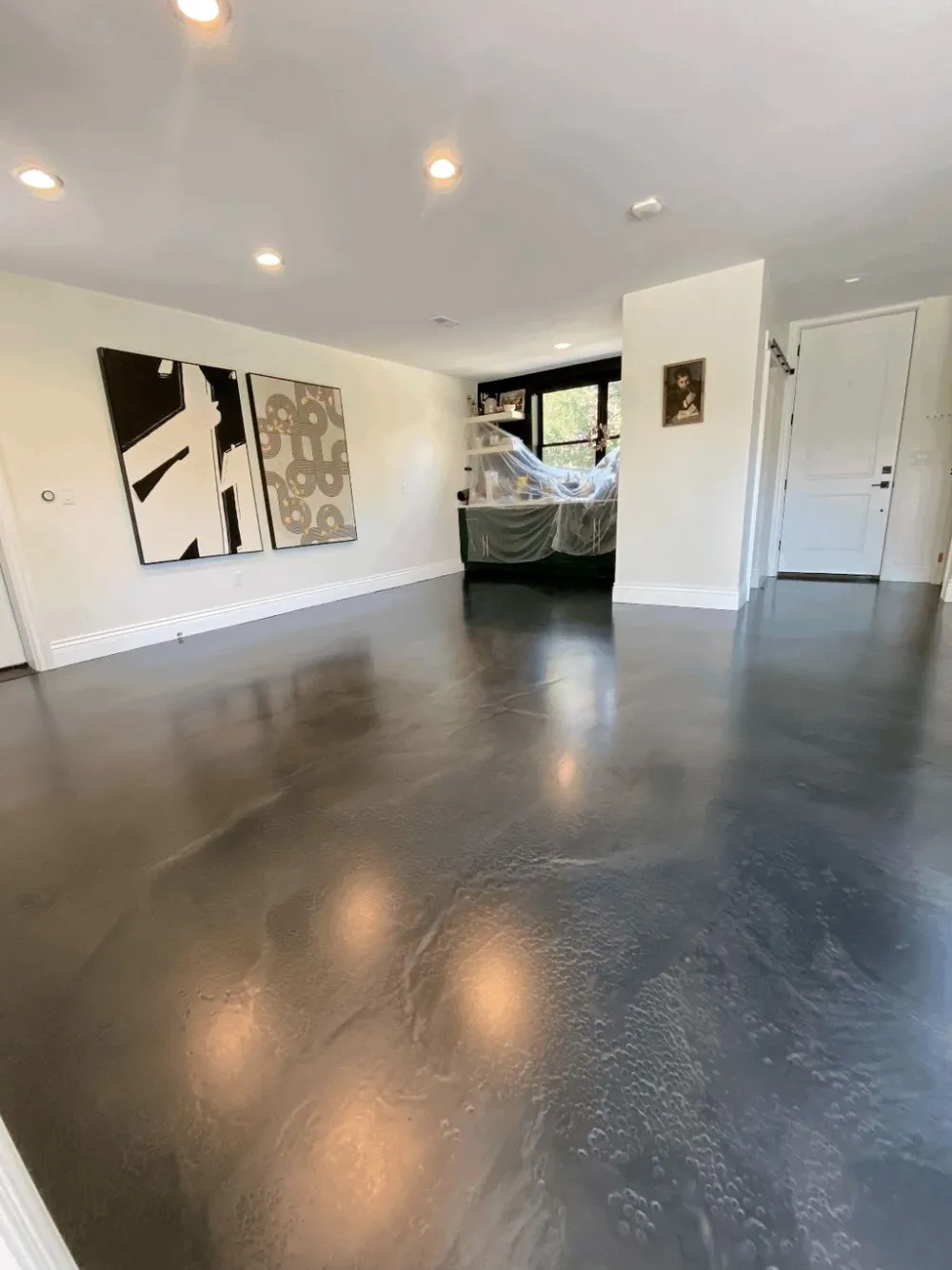
Basement Floor Options in Denver: Coating, Stain or Carpet?
Almost every Denver house has a basement, and finishing one is close to a rite of passage here. The floor is one of the decisions inside that project that people put the least thought into and regret the most.
Here is the honest comparison — but first, the thing that comes before any of it.
Start with moisture, not with flooring
A basement slab sits in contact with damp soil. Unless it was poured over an intact vapor barrier — and plenty of older Denver homes were not — it can move moisture vapor upward through the concrete continuously and indefinitely.
That matters for every option on this list:
- Put a non-breathable coating over a slab with high vapor drive and the pressure builds underneath until the coating blisters and delaminates. It looks like a bad coating job. It is not; it is an untested slab.
- Put carpet over it and you get persistent damp, odour and eventually mold.
- Stain and seal has the same vapor considerations as a coating.
So the first step is testing. If the reading is high, a moisture-tolerant primer or vapor-barrier system handles it. If there is genuine water entry rather than vapor — a crack, a failed sump, grading pushing water at the foundation — that gets fixed before any floor goes down. We will say so plainly rather than take the job and watch it fail.
Option 1: Carpet
The case for it: warm underfoot, soft for kids, familiar, cheap up front.
The case against it: it is the option that turns a small water event into a large one. A burst supply line, a water heater letting go, or a window well overflowing in a spring storm means carpet and pad come out, and if it sat wet for a day or two, remediation follows.
For a below-grade slab in a climate with real spring runoff, that is a meaningful risk to accept for softness you can get from rugs anyway.
Option 2: A coated floor
The case for it: sealed, so it cannot absorb water. If something leaks, you squeegee it, dry it and carry on. It kills concrete dust permanently — and dusting is the complaint we hear most about unfinished basements, because the fine gray powder gets into everything stored down there and tracked upstairs. It cleans with a mop, and it takes a home gym far better than carpet.
The case against it: it reads cooler underfoot, and it is a bigger up-front decision than laying carpet.
Where it wins outright: home gyms, workshops, laundry and mechanical rooms, storage areas, and any basement where water is a realistic possibility. If you are putting a rack and platform down there, this is not a close call — a coated slab handles dropped plates and rubber mats in a way carpet never will.
Finish options are the same as upstairs: solid color, a subtle flake blend that hides everything, or metallic if the space is a bar or games room and you want the floor to be a feature.
Option 3: Stained and polished concrete
The case for it: the slab itself becomes the finished floor. Stain penetrates and reacts with the concrete, so the color is in the surface — mottled, translucent, with real depth. It cannot chip or peel the way a film can, and in a walkout basement with daylight it looks superb.
The case against it: it hides nothing. Old patches, saw cuts, spill marks and where a wall used to stand will all show through and become part of the floor. On the right slab that is character; on a heavily patched or oil-contaminated one it is a mess.
Where it wins: walkout basements, finished living space, and anywhere a high-gloss industrial look would feel wrong.
The walkout basement case
Denver has a lot of walkouts, and they deserve a specific note: they get real daylight. That means UV, and at 5,280 feet UV is stronger than most of the country.
Straight epoxy ambers in sunlight. On a light-colored floor in a walkout, that shows. Any floor down there that sees daylight should carry a UV-stable polyaspartic top coat.
What we would actually recommend
For most Denver basements: test the moisture, then coat it.
The dust problem disappears, the water risk drops to near nothing, it takes a gym or a workshop without complaint, and a mid-tone flake blend or a stained finish looks warm rather than industrial. Put rugs where you want softness. You get the comfort without betting the room on the plumbing never failing.
If you are working through a basement finish and want a straight read on your slab — including whether it is a good candidate for stain — get in touch. The walk-through and the quote are free.