
Concrete Resurfacing Cost in Denver: Price Per Square Foot for Driveways, Patios, Pool Decks and Floors
HomeGuide, a national cost guide, puts installed concrete resurfacing at $3 to $7 per square foot. The number for your slab comes from a free on-site walk-through and a written quote.
Other national guides land close to that. HomeAdvisor puts the average at $3 to $5 per square foot, and Bob Vila publishes $3 to $9. Our page on concrete resurfacing and repair in Denver covers the repair work and the overlay itself.
Project totals depend on size and condition. HomeAdvisor says most homeowners pay between $1,000 and $5,000 for the job. Angi says materials are often no more than 20 percent of the total, and most of the rest is labor.
What does concrete resurfacing cost per square foot?
The overlay you pick sets the base rate. Here is what the national guides publish per square foot, installed.
| Method | Published installed cost per square foot | Publisher |
|---|---|---|
| Basic overlay or resurfacer | $3 to $7 | HomeGuide |
| Microtopping or skim coat | $3 to $7 | Angi |
| Self-leveling overlay on a basement slab | $3 to $7 | HomeGuide |
| Decorative overlay | $6 to $10 | HomeGuide |
| Stamped overlay | $7 to $20 | HomeGuide |
The three plain systems share one published band. Design work is what pushes the rate up.
A basic overlay is a thin layer of polymer-modified cement that grips the old slab. It covers scaling and pitting with one sound surface. Outside, it gets troweled or broom textured for grip.
A microtopping or skim coat is the thinnest option. Angi lists it at less than 1/8 of an inch. You get a fresh surface rather than depth.
A self-leveling overlay flows out flat on an interior floor. It takes the low spots out of a basement or shop slab before a coating goes down.
Decorative and stamped overlays add color and pattern. HomeGuide notes that decorative overlays are thinner and cost less than stamped ones.
What does each surface cost to resurface?
Bob Vila notes that the cost per square foot is about the same for most concrete surfaces. Size is what moves the total. Here is what the guides publish for common jobs.
| Surface | Published cost | Publisher |
|---|---|---|
| Driveway | $3 to $9 per sq ft | HomeAdvisor |
| Two-car driveway | $1,200 to $2,900 total | HomeGuide |
| Patio | $4 per sq ft on average | HomeAdvisor |
| Pool deck, basic overlay | $3 to $6 per sq ft | HomeGuide |
| Pool deck of 750 sq ft, basic | $2,250 to $3,750 total | Angi |
| Garage floor | $3 to $5 per sq ft | Bob Vila |
| Basement floor | $3 to $5 per sq ft | Bob Vila |
| Concrete steps | $150 to $500 total | HomeGuide |
| Sidewalk or walk | $3 to $7 per sq ft | HomeAdvisor |
| 20 by 20 garage floor (our estimate) | $1,200 to $2,000 total | Bob Vila rate, our math |
The last row is an estimate we ran. It takes Bob Vila’s $3 to $5 per square foot across 400 square feet.
In a garage, the overlay is the base layer. A garage floor coating goes over it to stand up to hot tires and ice melt.
A basement slab gets a moisture check before any overlay goes down. Once the new surface cures, our basement floor coatings go on top.
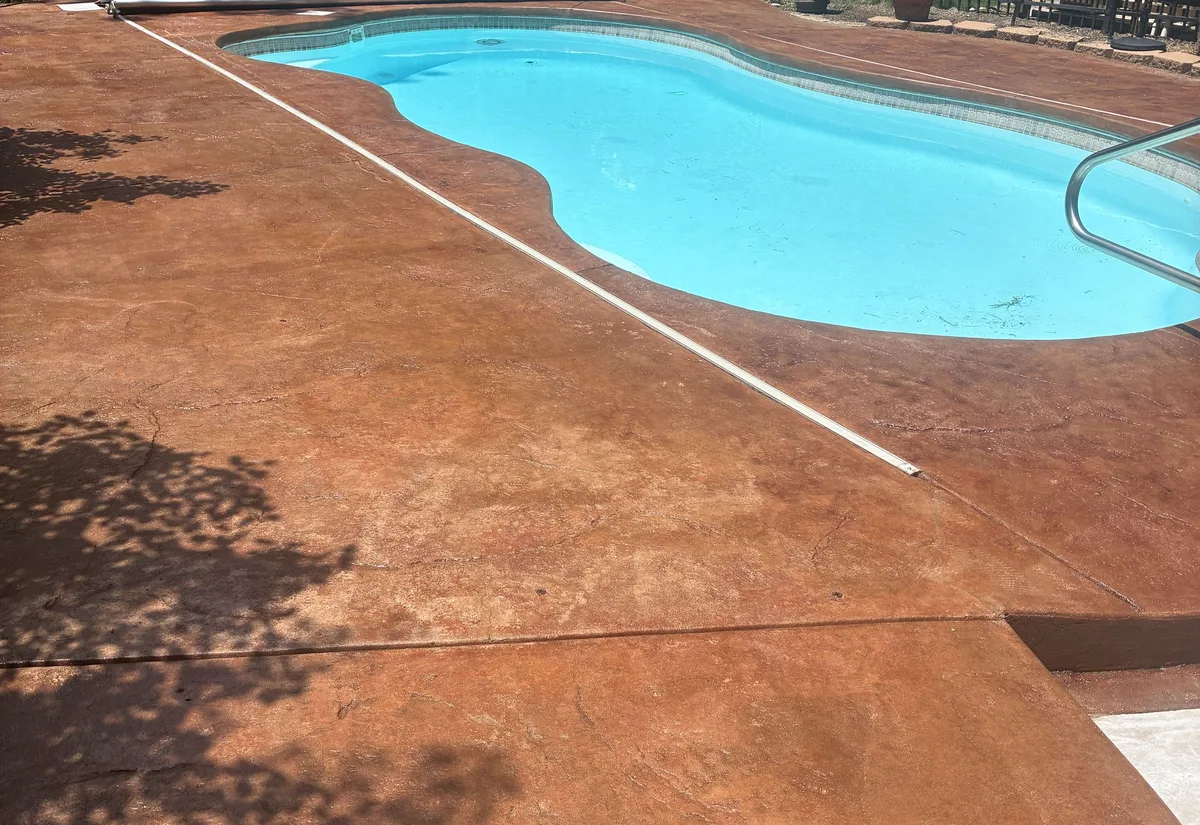
Angi notes that pool decks are often much larger than walkways and patios, so totals climb fast. Not every faded deck needs an overlay, though. On a recent pool deck, we repaired the cracks, stained the concrete and finished it with an acrylic top coat.
Before and after photos are on our pool deck and patio coatings page. Steps and walks get a troweled or broom textured overlay for grip.
What do crack and spall repairs cost?
Repairs come before the overlay, and the guides price them on their own. HomeGuide puts filling driveway cracks at $0.50 to $3 per linear foot. HomeAdvisor puts fixing cracks at $250 to $800.
Spalls are spots where the surface has popped loose. Angi puts spalling repair between $300 and $3,500. Size and the state of the area set where a job lands.
We chase and fill cracks and patch spalls and pitting before any overlay goes down. Control joints get cleaned and filled, and oil soaked spots get treated. A quote should list that work on its own lines.
Should you resurface or replace the slab?
Resurfacing works when the slab is sound and the damage sits in the top layer. Scaling, pitting, spalls and worn low spots all fit. HomeGuide says concrete resurfacing lasts 8 to 15 years before it needs repairs.
Replacement is the comparison point. HomeGuide puts a new concrete slab at $4 to $8 per square foot. It puts a new concrete driveway at $6 to $15, against $3 to $5 to resurface one. Angi says a driveway replacement can run $15 per square foot.
Replacing a slab also means tearing out the old one. HomeAdvisor puts smaller concrete removal jobs at $200 to $1,000.
HomeGuide also draws a line at depth. If the repair needs a new layer more than two inches thick, it calls replacement the better option.
When a slab is heaving, sinking or cracked through its full depth, an overlay will not fix it. That slab is a replacement question, and pouring new concrete is a different trade. We tell you so at the walk-through, before anyone spends money.
What moves the price of resurfacing?
Square footage comes first. HomeAdvisor notes that smaller projects may cost more per square foot, since some companies charge minimums.
Condition comes next. Angi puts basic work at $3 to $5 per square foot. It goes up to $9 where the slab needs extensive damage repair. Oil stains and open cracks add prep time.
The system sets the base rate, as the first table shows. Finish and color sit on top of it. HomeGuide puts concrete sealing at $1 to $3 per square foot installed. Outside, concrete sealing keeps water and ice melt out of the new surface.
A coating over a resurfaced garage slab is a second price. Our guide to garage floor coating costs covers that part.
Access matters too. Mixers and material may travel by hand to a back patio or down basement stairs. Concrete Network notes that hard access will likely bring additional fees.
Removing an old coating adds a step. A failed coating gets ground off down to bare concrete before any overlay goes down. Our guide to what epoxy flooring costs in Denver lists the published grind-off rates.
Why do Denver resurfacing quotes differ?
Front Range weather runs an aggressive freeze-thaw cycle. Water that gets into bare concrete freezes and pops the surface. That scaling and spalling is repair work, and it gets priced before the overlay.
The state sprays magnesium chloride on I-25 and I-70 all winter. Tires carry it home onto garage floors and driveways. It breaks bare concrete apart from the inside, and ice melt on steps and patios does the same.
Denver-area soils include expansive clay that swells when wet and shrinks when dry. That movement is one reason slabs crack and heave. A cracked slab needs crack and joint work, while a heaving slab is a replacement question.
The sun is intense at altitude, and it sets the top coat. Plain epoxy ambers outdoors, while acrylic and polyaspartic top coats hold their color. An exterior quote should name its top coat.
Big day-to-night temperature swings keep slabs moving. HomeGuide notes that concrete shifts at its expansion joints with the seasons. An overlay laid across those joints often cracks. We clean out the control joints and fill them with joint filler.
How to read two resurfacing quotes
Two quotes on the same slab can sit far apart for real reasons. Put them side by side on these points.
- Prep. Inside, look for diamond grinding. Outside, look for pressure washing plus grinding or profiling.
- Repairs. Crack filling and spall patches should each have their own line.
- The overlay. The product type should be named, along with how thick it goes on.
- Joints. Ask whether the control joints get cleaned and filled.
- Top coat or sealer. The product type should be named on the page.
- Square footage. The quote should state the number it priced.
A quote that names the prep, the overlay, the top coat and the footage can be compared. A single total at the bottom of the page gives you nothing to compare.
Getting a written number for your slab
We come out, measure the slab and look at the damage. Then we put the repairs, the overlay, the finish and the price in writing. The number holds unless the scope changes.
We have been coating floors since 2008, and we resurface residential and small commercial concrete. We cover the Denver metro and the Front Range, and we are open seven days a week. The walk-through and the written quote both cost nothing.