
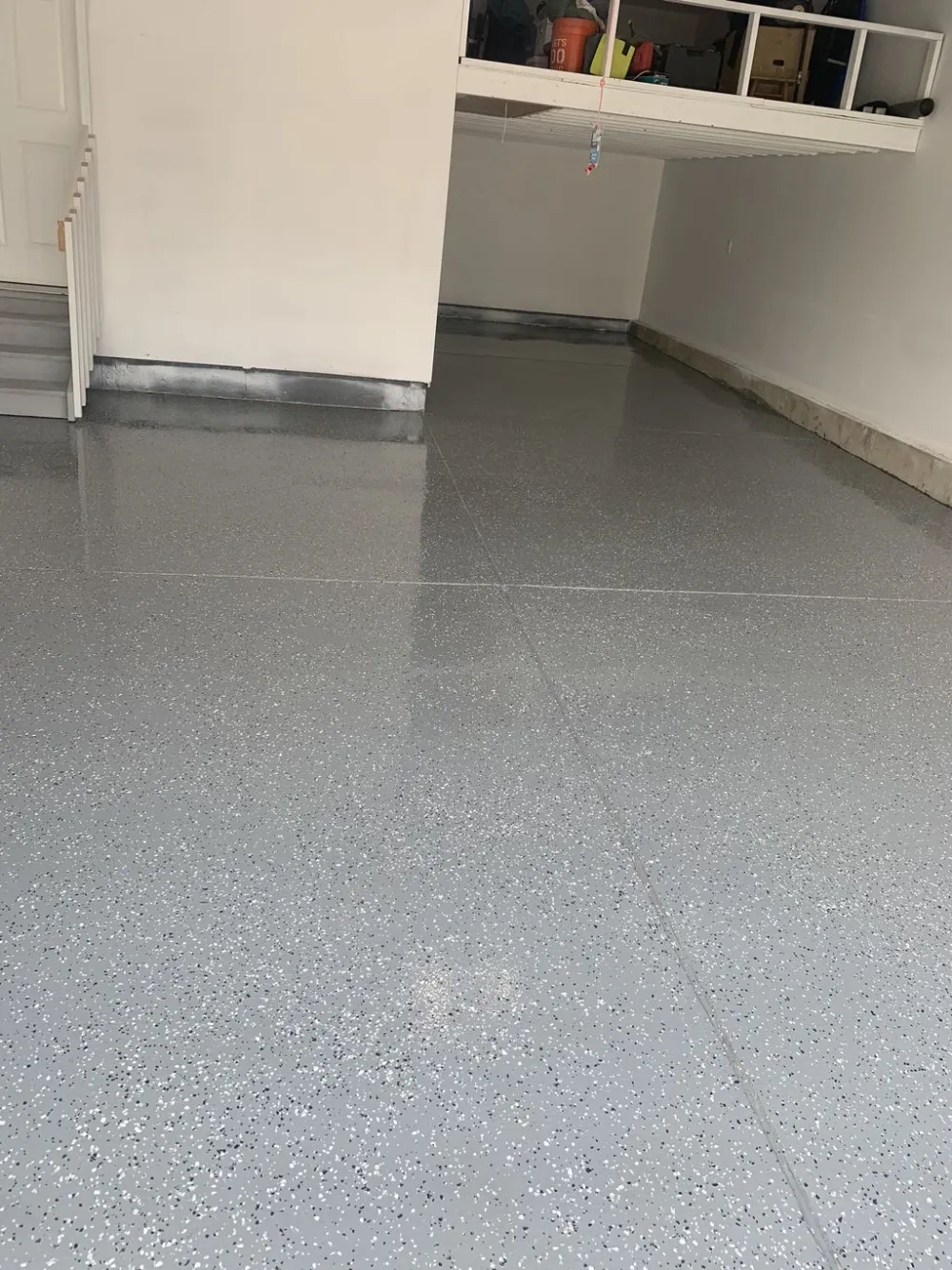
Epoxy vs. Polyaspartic: Which Garage Floor Coating Is Better in Colorado?
This is the question we get asked most, and the honest answer annoys people who want a single winner: for most Denver garages, the right answer is both.
Here is what actually separates them.
Cure time
Epoxy cures slowly — a full build takes days before you can put a car back on it. Polyaspartic cures in hours.
That difference is not a nice-to-have in a garage. It is the difference between your cars living on the driveway for most of a week and being back inside in a couple of days. For a commercial floor it is the difference between closing for a weekend and closing for a week.
There is a flip side worth knowing: polyaspartic cures so fast that the installer’s working window is short, and it gets shorter as the temperature rises. That is a professional-equipment-and-timing problem, and it is exactly why polyaspartic does not come in a DIY kit.
UV stability — this one matters more in Colorado
Straight epoxy ambers under ultraviolet light. It is a property of the resin, not a manufacturing defect, and it means a white or light-gray epoxy floor in a sunny space slowly shifts yellow.
Denver sits at 5,280 feet, where UV intensity is meaningfully higher than at sea level. Any garage with windows, a service door that stands open, or a west-facing door catching the afternoon sun is a candidate. So is a walkout basement or a sunroom.
Polyaspartic is UV-stable. That is the single biggest reason we use it as a top coat here, and it is non-negotiable over a metallic floor where the color is the product.
Cold-weather installs
Epoxy has a temperature floor. Below it, the resin will not cross-link properly and you end up with a soft, tacky floor that never fully hardens — permanently compromised, not fixable by waiting.
In an unheated Front Range garage, that rules out a real slice of the year. Polyaspartic keeps curing at temperatures where epoxy has quit, which is why our season runs longer than it otherwise would and why detached, unheated garages in places like Arvada are usually polyaspartic jobs.
Flexibility and slab movement
Epoxy is rigid. Colorado slabs move — a hard freeze-thaw cycle expands and contracts concrete constantly, and expansive clay soils along the Front Range add their own movement underneath.
Polyaspartic stays more flexible, so it tolerates that movement better. Neither product will bridge an actively moving crack forever, which is why cracks get chased and filled during prep rather than coated over and hoped about.
Cost
Epoxy is cheaper per square foot. Polyaspartic costs more — the material is more expensive and the fast cure demands more skill and tighter timing.
So why do we use both?
Because they are good at different things.
Epoxy is an excellent base coat. It builds real film thickness, levels minor imperfections, bonds hard to properly ground concrete, and carries pigment or flake beautifully. It does the structural work of the system, at a lower price per foot.
Polyaspartic is an excellent top coat. UV stability, abrasion resistance, flexibility and fast return to service are all exactly what you want on the surface that takes the wear and sees the light.
So the system that makes sense for most Denver garages is an epoxy or pigmented base with flake broadcast into it, sealed with a polyaspartic clear. You get epoxy’s build and value where it is hidden, and polyaspartic’s durability and color stability where it counts. You are not paying the premium across the whole system — just where it does the work.
The thing that matters more than either
Neither resin can save a badly prepared slab.
If the concrete was acid etched instead of diamond ground, if oil contamination was coated over, or if a moisture problem was never tested for, the floor will fail regardless of which product went down. Every failed floor we have been called to strip failed for one of those three reasons — not because somebody picked the wrong resin.
That is why we grind every slab, test for moisture where the situation calls for it, and treat contamination before anything else happens. Pick the system second. Let us walk your floor and we will tell you which one it wants.