
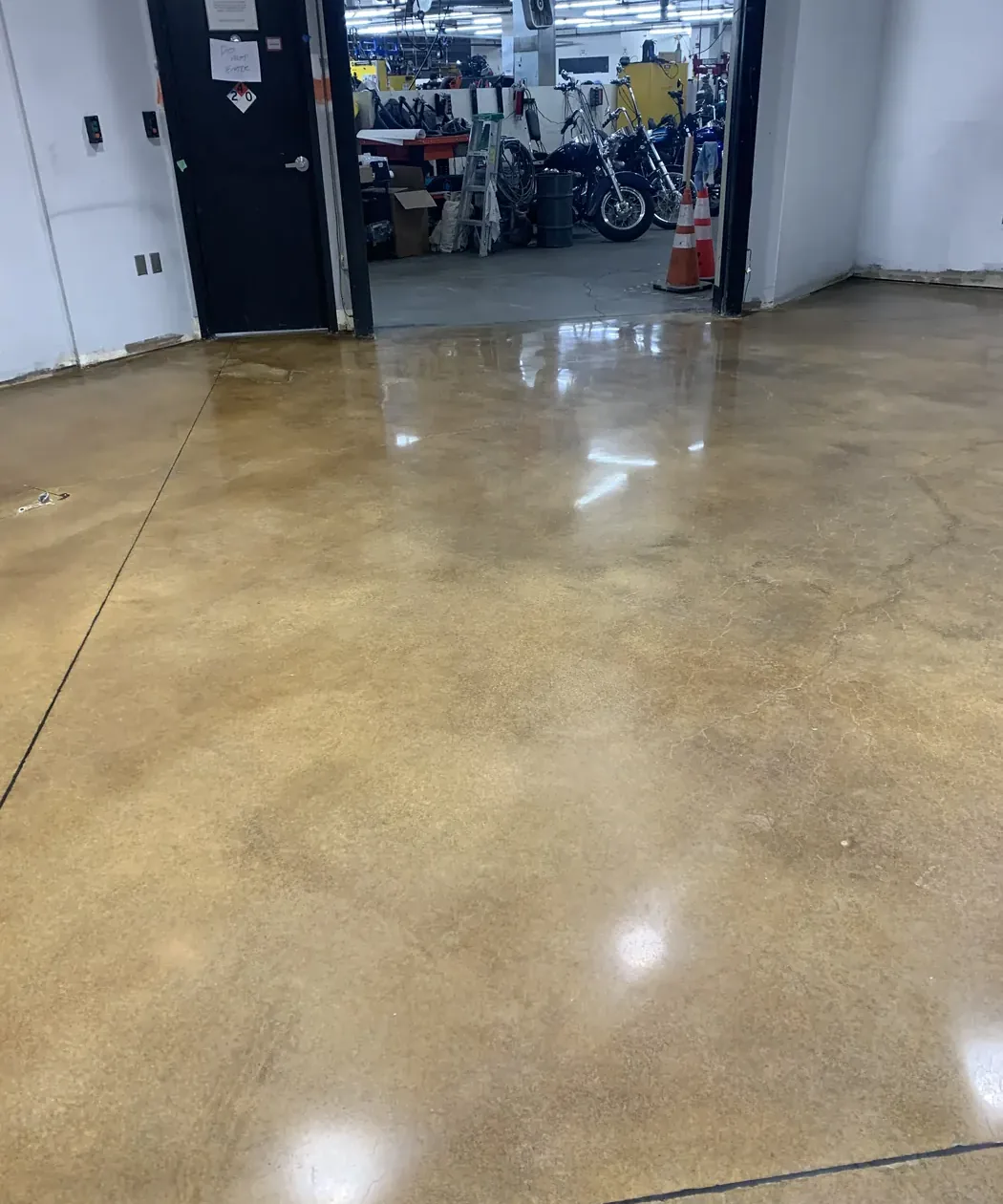
Polished Concrete Cost in Denver: Stained and Polished Floor Prices Per Square Foot
HomeGuide puts polished concrete floors at $3 to $12 per square foot for basic finishes. Decorative polished floors run $5 to $15 or more in the same guide. For stain on an existing floor, its staining guide lists $3 to $15 per square foot, labor included.
Angi puts professional polishing at the same $3 to $12 per square foot. Grind depth and gloss set most of the spread inside those ranges. Slab condition sets the rest, and your number comes from a free on-site walk-through and a written quote.
Polished concrete is the slab you already have, ground through finer diamond grits and then sealed. Stain puts color into that slab instead of a film on top of it. We do both as stained and polished concrete, and we price every floor from the slab in front of us.
What does polished concrete cost per square foot?
Two choices set a polished price: how deep the grind goes and how much shine you want. HomeGuide prices each one per square foot.
| Choice | Finish | HomeGuide cost per square foot |
|---|---|---|
| Grind depth | Cream | $3 to $8 |
| Grind depth | Salt and pepper | $4 to $10 |
| Grind depth | Exposed aggregate (rock cut) | $6 to $12 |
| Gloss level | Soft matte | $3 to $6 |
| Gloss level | Low sheen | $4 to $8 |
| Gloss level | Medium gloss | $5 to $10 |
| Gloss level | High gloss | $6 to $15 |
Grind depth decides what you see in the floor. A cream finish stays near the surface and shows very little stone. Salt and pepper cuts deeper and exposes fine aggregate in a speckled pattern. A rock cut goes deepest and shows the large stones.
Gloss decides how much light the floor throws back. HomeGuide ties the higher prices to extra grinding and polishing steps. A soft matte floor keeps a natural concrete look, while a high gloss floor reflects almost like a mirror. If you are still weighing a polish against an epoxy coating, our polished concrete vs. epoxy guide covers that decision.
What does stained concrete cost per square foot?
The number of colors and the detail in the design move a stain price. HomeGuide prices a single color at $3 to $5 per square foot. Complex designs with patterns run up to $25 per square foot in the same guide. Angi’s basic tier, one color with minor slab prep, runs $2 to $4 per square foot.
Stain chemistry changes the price too.
| Stain type | What it does | Published installed cost per square foot |
|---|---|---|
| Acid stain (also called reactive stain) | Reacts with the concrete for mottled, earthy color | HomeGuide: $3 to $25. Angi: $2 to $6 basic, $12 to $25 complex |
| Water-based stain | Water with polymers and pigment, for a more even color | HomeGuide: $3 to $15. Angi: about $2 |
| Dye | Dries faster than stain but fades in the sun | HomeGuide: adds $1 to $3 to a polished floor |
Acid stain reacts with the concrete itself, so every slab takes it a little differently. Water-based stain offers a wider variety of colors with a more uniform look.
Angi also points to water-based stain for basements, where poor ventilation makes fumes a concern. Dye stays on interior floors, since HomeGuide notes it does not suit outdoor concrete. The right chemistry depends on the room and the light it gets. HomeGuide adds that sealing is usually included in a stain job.
Indoor floors vs. patios and pool decks
Indoor stain work runs higher in the published numbers. HomeGuide puts a stained basement floor at $5 to $25 per square foot. It says indoor floors usually land in its middle to top service levels.
Outside, HomeGuide puts a basic or intermediate stain on an existing patio at $3 to $10 per square foot. To stain a 16 by 18 foot patio, the same guide lists $860 to $2,900. HomeGuide also notes polished concrete does not suit outdoor use. Our exterior work is stain with an acrylic top coat, or a coating system.
Colorado weather shapes that outdoor spec. Denver sits at 5,280 feet, where the sun is intense, and acrylic top coats hold their color in it. Water that gets into bare concrete freezes and pops the surface, and ice melt on patios does the same damage.
The staining guides we read price patios but give pool decks no line of their own. A pool deck is exterior concrete with wet bare feet on it. We broadcast anti-slip grit such as aluminum oxide into the top coat there.
A recent pool deck of ours had cracked and faded to a pale tan. We cleaned it and repaired the cracks. Then we stained it a terracotta red-brown and finished it with an acrylic top coat. The before and after photos are on our pool deck and patio coatings page.
What do dye, patterns and repairs add?
Add-ons sit on top of the base price, and both guides price the common ones.
| Add-on | Publisher | Published cost |
|---|---|---|
| Dye on a polished floor | HomeGuide | Adds $1 to $3 per sq ft |
| Stain or dye on a polished floor | Angi | $2 to $5 per sq ft |
| Scoring, patterns or engraving | Angi | $3 to $7 per sq ft |
| Crack repair, joint filling or patching | Angi | $1 to $3 per linear foot |
| Removing old coatings or adhesive | Angi | $1 to $3 per sq ft |
| Moisture treatment | Angi | $2 to $6 per sq ft |
Saw cuts give a stain design its lines. Angi’s top staining tier covers stencil work and saw cuts at $12 to $25 per square foot. HomeGuide’s top tier, with scoring to mimic stone or tile, runs $15 to $25.
Crack repair makes the floor sound, but on stain or polish the filled line stays visible. A slab that is heaving, sinking or cracked through its full depth is a different problem. No stain or polish fixes it, and the slab becomes a replacement question.
Old coatings and glue have to come off before stain can reach the concrete. Our interior prep is diamond grinding, which takes the slab down to clean concrete. Leftover carpet or tile glue has to come off the same way.
Deep oil is harder. Oil that has soaked into a slab resists stain and shows as blotches. A slab like that often suits a coating better, and our epoxy flooring cost guide prices that route.
Basements bring in the moisture line from the table. We test the slab first on every basement job, the same as on our basement floor coatings.
How often does the floor need resealing?
Sealer is the part of the floor that wears. HomeGuide puts concrete sealing at $1 to $3 per square foot. It says stained concrete should be sealed every 1 to 3 years. With that upkeep, the stain itself lasts 5 to 20 years.
On a polished floor, HomeGuide’s polishing guide puts sealer reapplication at every 2 to 5 years. Angi suggests a fresh polish every three to five years for most homes.
HomeGuide adds that a true polished floor does not strictly need sealer, because densifying hardens the surface. It still suggests a stain-guard sealer in kitchens and busy rooms.
We densify during polishing and then seal. The same sealer choice runs through our concrete sealing work. A penetrating sealer keeps the most natural look, and a film-forming sealer adds stain protection and gloss.
Outdoor sealers also take intense sun at altitude and Front Range summer hail. HomeGuide says a dirty but sound pool deck can take a power wash and reseal instead of resurfacing. It puts power washing at $0.35 to $0.77 per square foot.
What moves a Denver quote?
Four things set the number: square footage, slab condition, the finish and access.
Square footage comes first. HomeGuide says floors under 1,000 square feet often carry premium pricing of $8 to $15 or more per square foot. Larger areas cost less per foot, because the work runs more efficiently.
In totals, HomeGuide puts a 500 square foot polished floor at $4,000 to $7,500. A 1,000 square foot floor runs $7,000 to $12,000 in the same guide. Angi’s size table runs lower, at $2,000 to $7,000 for 500 to 1,000 square feet. Two guides give two answers for the same floor, which is why we measure before we price.
Slab condition comes next. Denver-area soils include expansive clay that swells when wet and shrinks when dry, one reason slabs crack. Freeze-thaw pops the surface of bare concrete that has taken on water. All of that gets repaired before stain or polish goes down.
The finish is the third lever. A deeper grind, a higher gloss, more stain colors and saw-cut patterns all add labor. Angi says labor often makes up 60% to 70% of a polishing job.
Access is the last one. HomeGuide says polishing a basement with limited access for equipment may cost 10% to 30% more. Rooms with many corners or columns also need more hand grinding.
Getting a written number for your floor
We come out, measure the floor and check the slab. The written quote spells out the prep and the finish along with the price. The number holds unless the scope changes.
If your slab is a poor candidate for stain or polish, you hear it at the walk-through. The walk-through and the written quote are both free. We work across the Denver metro and the Front Range, and we are open seven days a week.