
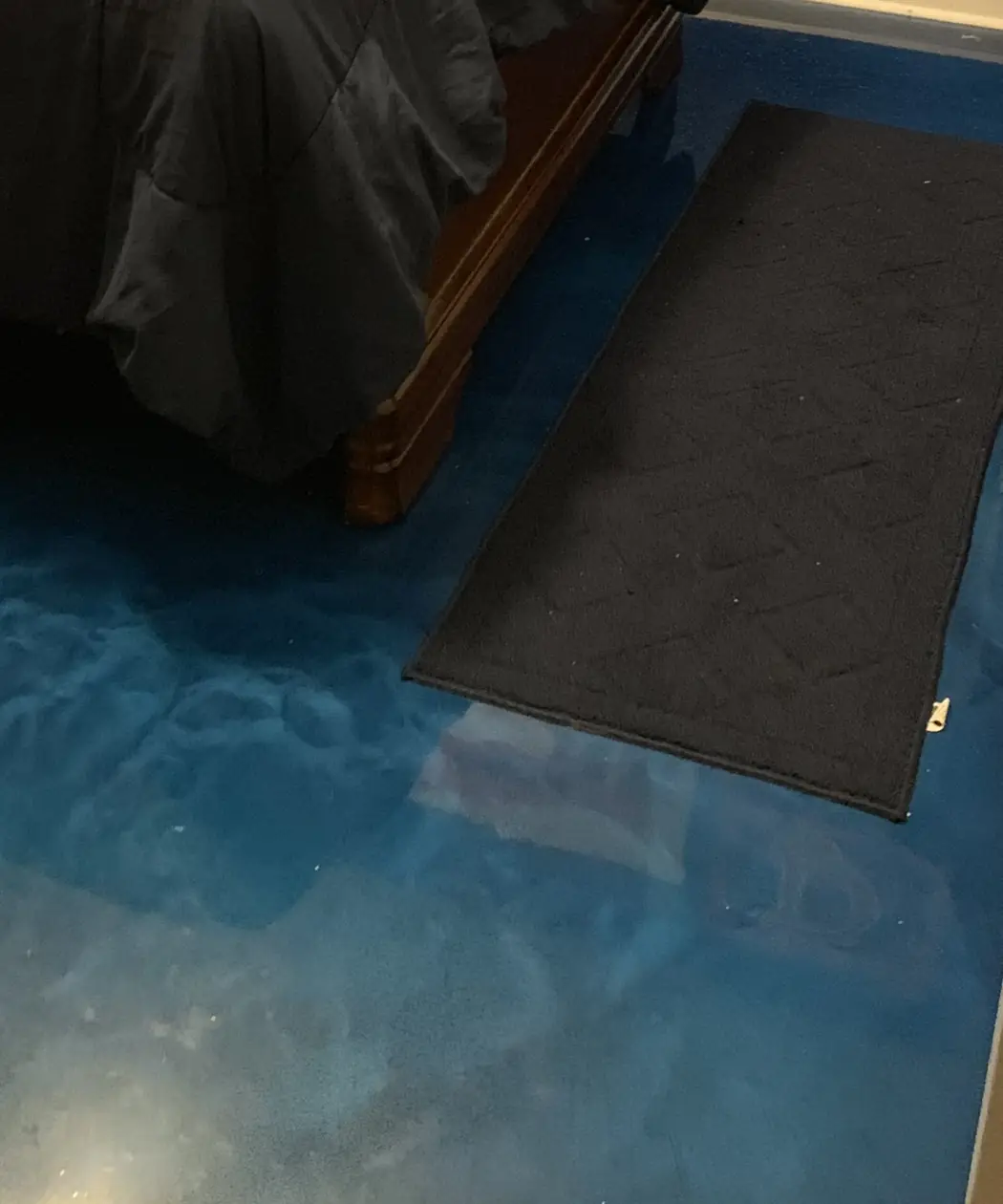
Basement Epoxy Floor Cost in Denver: Published Prices and What Moves Them
HomeGuide puts an epoxy basement floor at $1,200 to $20,000. It says the size of the basement and how much of the floor gets coated set where a job lands. The number for your basement comes from a free on-site walk-through and a written quote.
Below grade, the slab moves the price too. A basement floor can push moisture up from the soil, and any cracks get filled before a coating goes down. We install basement floor coatings across the Denver metro, and every one starts with a moisture reading.
What does a basement epoxy floor cost?
Two national cost guides publish basement numbers. Both are installed prices.
| Publisher | Basement size | Published installed cost |
|---|---|---|
| HomeGuide | 300 to 2,000 sq ft | $1,200 to $20,000 |
| Today’s Homeowner | 30 by 30 ft, or 900 sq ft | $6,750 |
HomeGuide’s room table puts a basement at 300 to 2,000 square feet. Its low end matches a small basement at its lowest rate per foot. Its high end matches a big basement at its highest rate. Most of that spread is size.
HomeGuide also counts how much of the floor gets coated. Coat only the gym corner or the utility side, and only that area gets priced.
Today’s Homeowner works one example. Its room table prices a 30 by 30 foot basement at an average $7.50 per square foot. That comes to $6,750, and the guide used the same average rate for every room in the table.
Our epoxy flooring cost guide lists the published rates per foot by system. It also carries a published figure for a 1,000 square foot basement.
Why does a basement get a moisture test first?
A basement slab sits against damp soil. Unless it was poured over an intact vapor barrier, it can push water vapor up through the concrete. Coat over that with the wrong product, and the pressure lifts the coating in bubbles. Our guide to why epoxy floors fail shows what that blistering looks like.
HomeGuide suggests asking any epoxy contractor whether they will test the floor for moisture first. We take that reading on every basement before anything goes down. The reading decides the build.
HomeGuide says solid epoxy should not be used on floors with moisture problems. Water-based epoxy is easy to apply, even when a floor is damp, it says. It is also the least durable type, and it may need recoating after a few years.
Solid epoxy costs more per gallon, but it lasts far longer. HomeGuide’s gallon prices run $40 to $100 for water-based epoxy and $70 to $150 for solid epoxy. It puts a water-based floor at 3 to 5 years, and a solid epoxy floor at 10 to 20 years.
Today’s Homeowner calls water-based epoxy the budget option, best for low-traffic areas like basements. A basement with a home gym or a workbench takes far more traffic than that.
If the reading comes back high, a moisture-tolerant primer goes down first. That adds to the build, and our epoxy cost guide carries a published price for a moisture barrier.
Liquid water is a separate problem. No coating holds back water pushing up from under a slab. If water is getting into the basement, that gets solved before any floor goes down, coated or not.
How do Colorado’s swelling soils affect a basement floor?
The Colorado Geological Survey publishes a guide for homeowners on swelling soils. It calls Colorado one of the most severely affected areas of expansive soils in the nation. Changes in soil moisture make the clay swell and shrink.
The guide says every major population center along the Front Range sits at least partly on swelling soils or shales. For floors, its answer is the floating slab, used for basement and garage floors resting on the soil.
The slab is cut loose from the walls, columns, stairs and utilities, so it can move. The guide says to expect some cracking in that slab.
For a coating, that means the slab underneath can still move. A crack that keeps moving can show back through a new floor. A slab that is heaving, sinking or cracked through its full depth is a replacement question. No overlay or coating will fix it.
What do repairs and access add to the price?
After square footage and the system, a basement quote turns on slab condition and access. Today’s Homeowner puts concrete repairs at $6 to $14 per square foot. It says that work comes first when a floor has cracks or chips to fill.
We diamond grind every basement floor before it gets coated. Cracks get chased and filled, and spalls get patched. That work is part of the prep, and the written quote lists it.
Some slabs need more than filled cracks. A floor that is pitted or low in spots gets concrete resurfacing and repair before it is coated.
Access counts below grade. Unless the basement walks out, every grinder and vacuum comes down the stairs. Our epoxy cost guide covers what that does to labor.
The floor also has to be empty before work starts. HomeGuide says clearing the area ahead of time may reduce the installer’s fees. If your things have nowhere to go, it says you may need a truck rental and temporary storage.
Which basement floor system fits your budget?
We coat basements in solid colors, flake, metallic and stained concrete. Each system has its own price per foot, and our cost guides price each one.
- Solid color epoxy. One sealed color, a good fit for a laundry or storage side. Our epoxy cost guide prices it per foot.
- Flake. A flake floor coating has colored chip broadcast into the base coat. The blend hides dirt and small flaws in the slab, and the epoxy cost guide prices it too.
- Metallic. A poured, marbled finish for a home bar or a game room. Our metallic epoxy floor cost guide has its own basement row.
- Stained or polished. The slab itself becomes the finished floor, so old patches and saw cuts show. Our polished concrete cost guide prices stained basement floors.
- Sealed. On a sound slab, a sealer is the lowest cost way to stop concrete dust. Our concrete sealing cost guide has a basement row.
A walkout with real daylight adds one more line. We top coat those floors with polyaspartic so the finish does not amber in the sun. Our polyaspartic garage floor cost guide shows what that resin adds over epoxy.
Is a coated basement floor cheaper than carpet?
Today’s Homeowner also lists carpet and laminate. It puts carpet at $2 to $10 per square foot, depending on the material and style. It puts laminate at $2 to $8 per square foot, depending on the thickness of the base layer.
Those ranges are not a like-for-like match with an installed coating. The guide does not say whether they include installation, and its hardwood line in the same list is a price before labor. Its own installed epoxy example used $7.50 per square foot.
So on price alone, the published numbers do not settle it. The bigger differences show up after a leak and under a home gym. Our guide to basement floor options in Denver weighs those side by side.
Getting a real number for your Denver basement
We measure the floor and take a moisture reading on an on-site walk-through. Then we write up the prep and the system, with the price. The number holds unless the scope changes.
The company has been coating floors since 2008. We coat basements across the Denver metro and the Front Range, and we are open seven days a week. The walk-through and the written quote both cost nothing.